
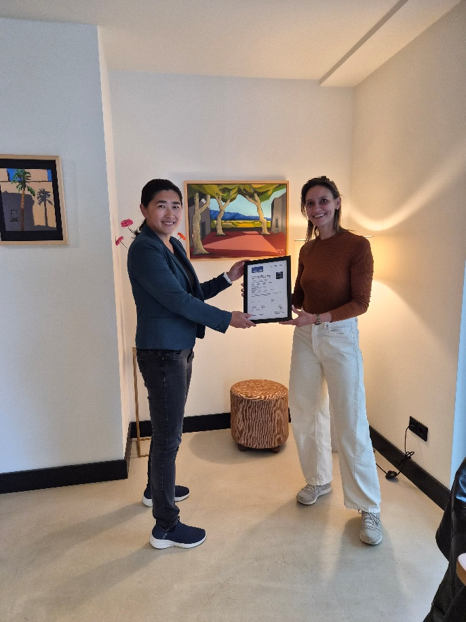
At Modelverse, this past year we've been quite busy with one task in particular: getting certified for the ISO27001:2022 framework. And lo and behold, just a couple of weeks ago we did it. Our external auditor TÜV NORD confirmed that our organisation is wholly compliant with the framework, and so we are one step further along our journey. It is no small feat, especially because we are still a rather small organisation. In any other situation it would seem overambitious for a startup with fewer than 15 employees to get certified — so how did we do it? Well, we had an ace up our sleeve: our very own Cybersecurity Risk and Compliance Management platform. In this article I'll be diving into our approach, how the platform made everything possible, and how you can also get certified while only needing a fraction of the resources.
Getting ISO27001 Certified: the Ins and Outs
So, what does getting certified actually involve? At its core, ISO27001 requires you to build and maintain an Information Security Management System (ISMS) that systematically identifies, assesses, and treats the risks to your organisation's assets. Sounds straightforward, but it can be trickier than expected, as the standard comes with 93 controls to consider, spanning everything from physical access and third party management to incident response and business continuity plans. Each control needs to be evaluated on whether and how it is applicable to the organisation, followed by a plan to address it. Arguably, then the most daunting task is proving that you have in fact implemented it. The audit process is highly rigorous on this aspect, and for most organisations (especially smaller ones) this is where the process starts to feel overwhelming. The typical approach involves (armies of) consultants, convoluted spreadsheets and months of manual evidence gathering; all before an auditor has even set foot through the door.
Our approach was fundamentally different. We exchanged the patchwork of spreadsheets for a single, coherent source of truth and ran the entire certification process through our platform from day one. Now this might read a bit like "oh, you put everything in a folder in SharePoint and called it a day", but that is not the case at all. The Modelverse platform is built on the ideas of connectivity and traceability: assets carry risk ratings, which are fitted to risk scenarios, capabilities are mapped to those scenarios, roadmaps are built on capabilities. Thus, everything feeds into one coherent, unified picture of your organisation's security posture. This interconnectedness is what makes smart automation possible. Evidence no longer needs to be gathered manually, controls don't need to be cross-referenced across five different documents, and nothing falls through the cracks. The result was an ISMS that was audit-ready not just at the finish line, but continuously throughout the process; so much so that during the audit itself, we only needed to step outside the platform once.
Certification Without a Compliance Department
So how does this play out for a team of fewer than 15 people? In our case, the effort was primarily driven by our CISO, with management coming together periodically to iron out uncertainties and peer review the process. No dedicated compliance department, no external consultants; just a small team and a platform that does the heavy lifting. Because the platform is intuitive and keeps everything connected, all you really need is a handful of people who are familiar with information security. For startups and scale-ups weighing up whether certification is even feasible, that changes the calculus entirely. And for larger organisations it simply reduces the cost, time and effort.
What Comes Next?
One of the less obvious but perhaps most important advantages of running your ISMS through an interconnected platform is that the groundwork you lay doesn't go to waste. The risk assessments, control mappings, evidence and ownership structures you build for one framework carry over. Getting re-certified becomes straightforward, and adding new frameworks (whether that’s SOC 2, NEN 7510, DORA or something else entirely) becomes a matter of extending what's already there rather than starting from scratch. Certification stops being a one-time project and becomes a continuous, compounding capability. If that sounds like something your organisation needs, we'd love to show you how to achieve it with Modelverse. Book a demo or get in touch through our contact page, no commitment required.